Translation vs Localization: Why Your Arabic Site Is Present but Not Found
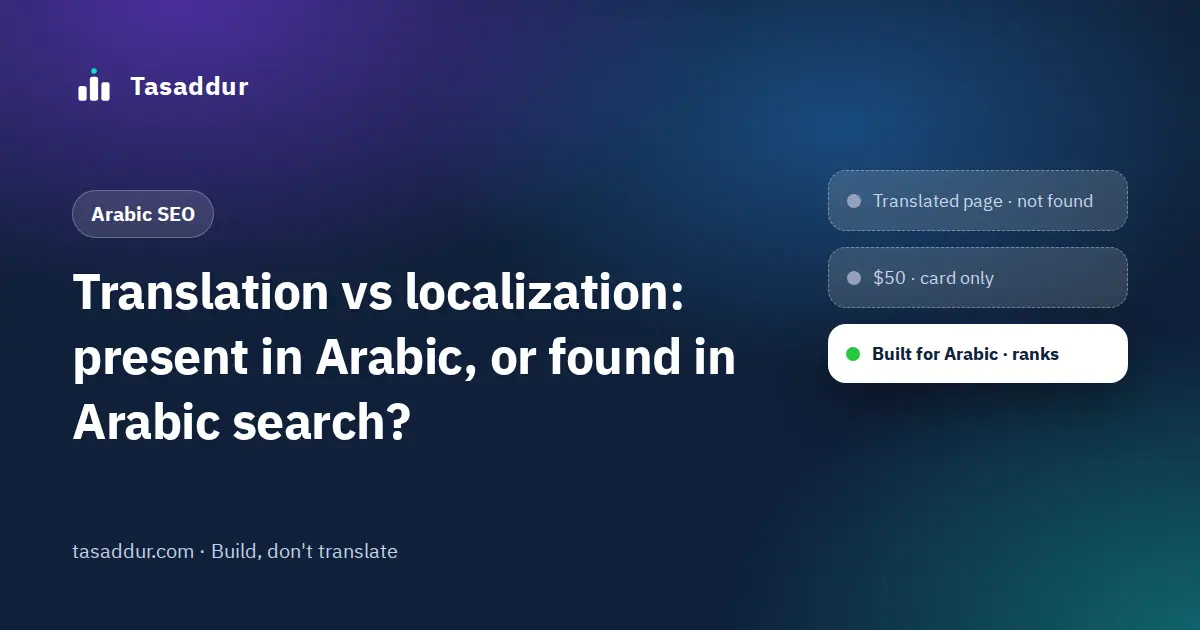
Translating your website into Arabic makes you present. It doesn't make you found. The pages exist, the grammar is fine, and an Arabic-speaking visitor who lands on them can read every word. But almost nobody lands on them, because Arabic search has its own keywords, its own intent, and its own technical rules, and a translation inherits none of that.
In simple terms, translation moves your words into Arabic. Localization rebuilds the page around what Arabic-speaking customers actually type into Google, in the form they type it, with the currency, payment methods and proof they expect to see. In this guide, you'll learn why translated pages stay invisible, how Arabic search behaviour differs, what a translation silently loses, and how to tell which one you have.
What Is the Difference Between Translation and Localization?
Take a line most e-commerce sites carry: "Free shipping on orders over $50." A translator turns it into correct Arabic. It still talks about dollars in a market that pays in riyals or dirhams, and about shipping to nowhere in particular.
A localized version says something like "Free shipping across Saudi Arabia on orders over SAR 200." Nobody translated that sentence. Someone who knows the market wrote it, because the promise itself changed: the currency, the threshold, the geography. Localization applies that same rewrite to every layer of the page, from the keyword in the title tag to the payment logos in the footer to the direction the arrows point.
A quick warning if you go looking for the Arabic term. On its own, the word for "localization" (توطين) in Saudi search results mostly means Saudization, the national employment policy. Arabic marketers say "content localization" or "Arabization" to avoid the collision. Small detail, but it's a good preview of how literal transfer fails.
Why Do Translated Pages Stay Invisible in Arabic Search?
Google reads the language of a page from its visible content, not from the lang attribute or the URL, so it will correctly file your translated page as Arabic. Detection isn't the problem. Matching is. Google shows a page when its words and intent line up with what someone searched, and a translation produces the words a bilingual professional would choose, not the words a customer in Riyadh types on their phone.
Here's a scenario we see constantly. A global electronics brand translates its product pages carefully, and every heading now says "mobile phone" in formal Arabic (هاتف محمول). Textbook-correct. But shoppers in Saudi Arabia type "jawwal" (جوال), and shoppers in Egypt type "mobile" (موبايل). The translated page competes for a term almost nobody uses in day-to-day search, while a locally built page competes for the term people actually type. One word choice, and the page is either in the race or not.
The second problem is structure. A translation keeps the original order of arguments. Your English page might lead with a technical spec because that's what your home market compares. A Gulf buyer often wants to see local warranty and instalment options first. Translate the layout as-is and the page answers questions nobody in the new market asked.
How Does Arabic Search Behaviour Actually Differ?
Most teams treat Arabic as one language searched one way. In practice there are at least three layers, and each one changes which keywords you should target.
- Formal Arabic vs dialect. People search in Modern Standard Arabic for official topics (regulations, health, education) and drift into dialect for everyday buying and local services. A Saudi user asking why their site isn't on Google will often phrase it in dialect, and there are barely any pages written for that phrasing, while the formal version is crowded.
- English words inside Arabic queries. A large share of product searches keep the brand or model name in Latin letters and finish the sentence in Arabic, like "iPhone used Riyadh." A literal translation Arabizes the brand name and loses that entire query.
- Multiple spellings. "Google" alone has three common Arabic spellings (جوجل, قوقل, غوغل). A translated page picks one. A localized page knows which one its audience uses and covers the others where it's natural.
None of this means writing your whole site in slang. It means finding out how your audience phrases each topic before you write it. That research step is where we start every Arabic SEO engagement, and it's the step translation skips by definition.
What Does a Literal Translation Lose?
When we audit a translated site, the same gaps show up almost every time. Use this as a checklist against your own Arabic pages.
| Layer | What translation gives you | What the market expects |
|---|---|---|
| Keywords | The dictionary equivalent of your English term | The term customers type (often dialect or mixed-script) |
| Intent | Your home market's question | The local question (price, delivery, instalments, warranty) |
| Currency & payment | "$50", credit card only | SAR / AED, local cards such as mada, buy-now-pay-later options |
| Seasons | Black Friday, back-to-school | Ramadan, Eid, National Day, and the local sale calendar |
| Trust signals | Head-office address, global reviews | Local address and phone, clear returns policy, commercial registration |
| Headings | The English outline in Arabic | Questions phrased the way Arabic searchers phrase them |
Every row is fixable after the fact. It's just more expensive after the fact, because every fix touches indexed pages and existing links. Building it right costs less than rebuilding it.
Is Localization Only About Language?
No, and this is the part translation vendors can't help with. Most of the Arabic-site problems we find are technical, and a perfect text sits on top of them without fixing anything.
- RTL (right-to-left) layout. Arabic reads right to left, and the page has to behave that way: navigation, icons, arrows, form fields, tables. Text alignment alone isn't enough. A page that reads Arabic but behaves English tells the visitor the Arabic version was an afterthought.
- hreflang tags. These tell Google that this Arabic page is the counterpart of that English page, so the right version shows to the right searcher. Missing or broken hreflang is one of the most common faults on translated sites.
- Fonts and speed. Arabic font files are typically heavier than Latin ones. Choose and load them badly and the page slows down or flashes a fallback font before the real one arrives.
- Structured data (Schema). Organization, Product and FAQ markup needs Arabic values too, not an English copy hidden in the code of an Arabic page.
- URLs and title tags. Slugs and titles need a deliberate decision (Arabic or English), not whatever the translation tool produced.
This layer is why we treat Arabic SEO and Arabic web development as one job. The technical side is covered in detail on our Arabic web development page.
How Can You Tell Whether Your Site Is Translated or Built for Arabic?
You don't need paid tools for a first diagnosis. Open your Arabic pages and answer honestly. Each "no" is search visibility you're leaving on the table.
- Is the main keyword in your Arabic title tag the term your Arabic customer types, or a translation of what your English customer types?
- Are prices in the local currency, and are the payment methods shown the ones your audience uses?
- Do menus, forms and arrows behave correctly right-to-left on mobile?
- When you search your brand plus a product in Arabic, does the Arabic page appear, or does Google serve the English one instead?
- Do your About and Contact pages carry an address and phone number for the Arabic market?
- Are your FAQs the questions Arabic customers actually ask, or translations of another market's questions?
- Were the examples, photos and testimonials taken from this market, or carried over unchanged?
Mostly "no"? You have a translated site. That's a starting point, not a verdict.
When Is Translation Actually Enough?
Translation isn't a mistake in itself. Legal pages, terms of service and technical manuals need faithful meaning transfer more than marketing rebuilds. And a company that isn't selling into the Arab market yet, but wants to be understood if an Arabic visitor arrives, can live with a good translation for now.
The difference is that those pages aren't expected to rank or convert. Any page you want customers from, whether a service page, a product page, or an article aimed at a real search question, needs to be built, not carried over. The practical rule: translate what must be understood, build what must be found.
Key Takeaways
- A translated Arabic site is present online but usually absent from Arabic search results, because it targets words customers don't type.
- Arabic search splits by formal vs dialect, mixed English-Arabic queries, and multiple spellings. Keyword research has to happen in the market, not in a dictionary.
- Localization also means currency, payment methods, seasons, local trust signals, and a heading structure shaped by local questions.
- The technical layer (RTL, hreflang, fonts, Schema, URLs) is where most translated sites break, and no translation touches it.
- Translate legal and reference pages. Build every page you expect to bring customers.
How Does Tasaddur Approach This?
We start from search behaviour, not from your English copy. We collect the terms your target audience types for each topic, classify the intent behind each one, and then write the Arabic page from scratch to answer that intent in the reader's own language, with the technical layer (RTL, hreflang, fonts, structured data) handled as part of the same work. If there's an English version, it's written for its own audience too, so neither version is a translation of the other.
We've put the two routes side by side, with cost, timeline and what you actually get, on our Arabic SEO vs translation comparison page.
Frequently Asked Questions
What is content localization?
Content localization is adapting a page's text, images, currency, examples and technical structure so it reads as if it were written for a specific market from the start, rather than carried over from another language. It includes choosing the keywords that market actually uses in search.
What is the difference between translation, localization and transcreation?
Translation carries the meaning of a text into another language. Localization adapts the whole page (words, currency, examples, layout direction, technical tags) to a specific market. Transcreation rewrites creative copy such as slogans and campaign headlines from scratch so the idea, not the wording, survives. For a website that needs to rank in Arabic search, localization is the baseline and transcreation is used for the handful of lines where a literal version would fall flat.
Does Google penalize machine-translated websites?
There is no penalty called "machine translation." Google's spam policies do treat automatically generated content published at scale without human review as spam. In practice, the bigger issue is that unreviewed machine translation produces text nobody searches for, so the pages underperform on relevance long before any policy comes into play.
Should my Arabic keywords be in formal Arabic or dialect?
It depends on the topic and audience. Formal Arabic suits official and specialist topics; light dialect suits everyday buying and local services. The working rule is to check how your audience phrases each topic and write in that register, rather than choosing one for the whole site.
Do I need a separate domain for each Arab country?
Not necessarily. Several Arabic markets can be served from one domain using subfolders or subdomains with correct hreflang tags. Separate domains become worth considering when prices, shipping and content differ substantially between markets.
How long until a localized Arabic site starts ranking?
There's no fixed number. Timing depends on domain age, link strength and how competitive each keyword is. Pages built around low-competition terms tend to show up before pages competing for broad ones, and progress is measured in Google Search Console rather than guessed.
Can an existing translated site be localized, or do I have to start over?
An existing site can be localized, and the work usually starts with the pages meant to bring customers, then expands. Starting over makes more sense when the technical foundation itself isn't built for Arabic, because fixing it page by page costs more than rebuilding it.
Not sure how your brand shows up in Arabic search? Send us your URL through our contact page and we'll come back with a plain-language read of what's visible in Arabic search and what isn't, no obligation.